
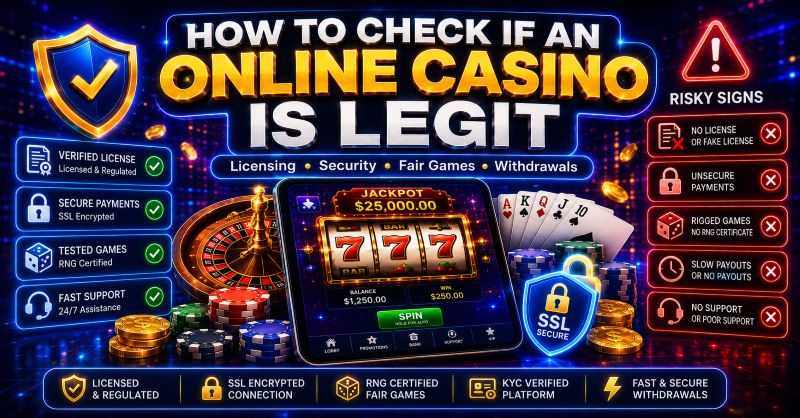
A friend sent me a text last month and asked if he could safely put money into a casino site he had recently come upon. The site appeared very modern, offered a gigantic welcome bonus and clearly stated “Fully Licensed & Secure” right near the top of their home page. That statement alone should immediately make you skeptical rather than assured, because virtually anyone can place that language in their footer. The problem isn’t really whether a casino states they are “legitimate,” it’s whether you can easily verify it yourself before handing over your credit card details.
Checking whether an online casino is a legitimate site, is relatively simple once you understand the few factors that matter: verified license, true security, tested games, fair bonus terms, and a history you can see outside of the casino’s own promotional materials. All of these do not require specialized knowledge. Just knowing where to look and what a truthful response looks like is enough.
How to Verify an Online Casino License
All licensed online casinos operate via a gambling license from some regulatory body, and that license number should be somewhere on the site — usually in the footer, sometimes on an “About” or “Licensing” page. Most people stop there. But a license number by itself is nearly meaningless unless you check it against the regulator’s publicly maintained database, because fake or lapsed license numbers frequently appear on unscrupulous websites.
The regulatory agency behind the license indicates how accountable the operator is to that regulatory authority. The UK Gambling Commission operates one of the stricter regimes in the online gambling space, requiring mandatory audits, enforcing restrictive advertising policies, and providing substantial financial penalties to operators who violate the policies. The Malta Gaming Authority is another well-recognized name seen commonly among European-facing online casinos, with its own compliance and reporting standards.
Curacao eGaming licenses represent a huge portion of the online casino market as well; although historically, it has been a softer touch jurisdiction, thus, having a Curacao eGaming license does not provide the same level of assurance as a UK Gambling Commission license. While none of this implies that all Curacao eGaming licensed casinos are inherently unreliable, several well-managed casinos are operated under that jurisdiction; however, it provides yet another piece of data — not the entire story.
Once you have located the license number, enter it into the regulatory authority’s public database lookup tool. Both the UK Gambling Commission and Malta Gaming Authority maintain publicly searchable databases allowing users to confirm if the license is current, if the license corresponds with the operator’s actual corporate name, and if the license has not been suspended. By itself, this single action identifies more fake casinos than almost any other action you can take, since creating a credible-looking website is an easy task; however, creating false entries in a government database is much more difficult.
Security features to look for
Before you type in your credit card number or attach your banking or payment processor details to deposit into an account, ensure that the connection itself is secure. Find the https designation and padlock symbol in the address bar indicating that SSL encryption is being utilized to safeguard data transmitted between your browser and their server(s). At this stage, utilizing SSL encryption is de facto for virtually every online business, including casino sites requesting sensitive financial details. Thus, failure to display SSL encryption on a casino requesting financials from you constitutes an instant red flag rather than an insignificant omission.

Account verification represents equal importance, despite potentially presenting inconvenience initially. Any regulated, legitimate operator will conduct KYC (Know Your Customer) verifications (usually requiring a photo ID and sometimes proof of residence), and AML (Anti-Money Laundering) monitoring continuously throughout user account activity. Although this verification process may create frustration for customers by delaying potential cashouts for a day or two in advance, it is ultimately a positive indicator of legitimacy as opposed to an impediment.
Casinos with no verification requirements prior to making deposits and subsequent withdrawals enabling users to deposit large amounts without conducting any identification checks whatsoever are typically either operating illegally or operating in jurisdictions with little regulatory oversight — and both tend to correlate with payout issues moving forward.
Payment processing choices are less overtly apparent indicators of legitimacy; nonetheless still serve as useful signals. Reputable online casino operators generally associate themselves with established payment processors, banks, and e-wallet services whose own compliance obligations force them to scrutinize closely their relationships with any casino wishing to utilize their payment system.
Since traditional payment systems and card networks typically afford consumers avenues to dispute transactions where cryptocurrency-based payment processors do not — the presence or absence of payment options such as wire transfer or direct bank transfer can indicate whether or not an operator is attempting to limit users’ ability to seek recourse should any issue arise during their use of the casino.
Fairness & Game Testing
Reputable online casinos test their games independently – not solely perform internal tests. Seek references to third-party testing labs such as eCOGRA, iTech Labs, GLI, or BMM Testlabs normally referenced in fairness or responsible gaming sections of each casino site. These labs examine each game’s Random Number Generator (RNG) to ascertain whether it produces truly random outcomes, thereby confirming that the Return To Player (RTP) percentage listed in-game advertising accurately reflects reality.
Each certified game demonstrates evidence of successful statistical testing of millions of simulations. Additionally, in order for an online casino to demonstrate credibility in regard to fairness testing, an established provider will frequently reference said certification directly in-game.
Disclosing RTP figures for individual games is another useful litmus test. Typically, individual slots should list their RTP figure somewhere accessible (often via an “i” icon or help menu inside the game), and it usually ranges between 92% and 98%, depending on the game title. If neither RTP nor the location in which it might be found is provided by a casino for any game titles or if customer service cannot identify where it may be found, that represents an identifiable gap in practice for tested and licensed operators; since disclosing RTP figures is expected baseline practice not an optional advanced feature.
In addition to noting whether the casino lists RTP figures for individual games, it is equally prudent to recognize whether the casino utilizes established names of recognizable game providers (as opposed to unknown/anonymous developers). Established game providers have their libraries tested multiple times by multiple testing laboratories across numerous licensed jurisdictions; therefore, demonstrating additional confidence in that particular aspect beyond a singular certification.
Bonuses & Withdrawals Terms
Terms surrounding bonuses are often where seemingly legitimate online casinos gradually become predatory. An offer that seems too good to pass up, i.e., a 200% welcome bonus may seem great at first glance; until you dig through the fine print buried on page 3 of the T&C’s, and discover that you must wager the bonus amount 40+ times before any winnings can be withdrawn. High wagering requirements are common throughout the industry, but high wagering requirements equate to lower chances of successfully withdrawing winnings from a bonus therefore, read those terms before committing to a promotion, not after.
Similarly, withdrawal terms demand identical scrutiny. Locate stated payout speeds for your preferred payment method since legitimate casinos typically pay e-wallet withdrawals within 1-2 business days; and card withdrawals within 5-7 business days (sometimes longer based on your banking institution); although legitimate casinos never refer to withdrawal limits imposed after winning that only appear post-deposit; nor describe extended withdrawal processing periods lacking reasonable explanations. Likewise, segregated player funds are another item worthy of consideration; since regulated operators are often mandated by regulators to segregate player deposits from operational funds; thereby protecting player balances from being considered company assets in case of operator insolvency.
Red Flags Indicating Scams
There are repeated patterns found across numerous fake or predatory online casinos; identifying these rapidly saves you considerable time investigating various aspects individually.
- First, a lack of verifiable license number(s) or a license number that fails to correspond with any listing in the regulatory agency’s public database when searched directly.
- Second, consistent reports of delayed payments or denied withdrawals from various users across numerous independent review sites and forums, as opposed to one isolated incident report.
- Third, excessively high bonus wagering requirements (e.g., 60x+); which would render clearing them nearly mathematically impossible for average players.
- Fourth inaccessible customer support or significantly slow responses (beyond 24 hours) for simple questions related to licensure status; RTP; and/or testing certifications.
- Lastly aggressive solicitation promoting deposit-related actions; particularly those framed as urgent/time-sensitive, which is another classic example of coercion intended to circumvent due diligence on behalf of most players researching prospective online casinos prior to depositing funds.
Pre-Cash Deposit Checklist for Legit Casinos
Prior to making a deposit at a new casino site, it is helpful to consistently go through similar rapid verification steps; as opposed to relying on initial impressions regarding professionalism displayed by the site itself.
- Step1: Locate the license number(s) associated with your target casino and confirm same via the regulator’s publicly accessible database; NOT via the casino’s own page(s).
- Step 2: Verify that HTTPS protocol AND SSL encryption are enabled, along with verifying that account verification processes via KYC are enforced prior to permitting withdrawals.
- Step 3: Determine if RTP figures are made available for individual games and if the casino references recognized third-party testing laboratories (such as eCOGRA, iTech Labs, GLI, etc.).
- Step 4: Read and understand terms related to bonuses and wagering requirements BEFORE electing into any promotions; NOT AFTER.
- Step 5: Search independent reviews from players primarily referencing their experience with withdrawals; as historical evidence indicates that user reviews pertaining to withdrawal timelines frequently reveal substantially more about an operator’s true practices than any other category of review you will likely encounter.
None of these tasks require significant time or effort once completed a few times; similar to learning how to review return policies or lease agreements. Authentic online casinos want you to verify these items as they represent elements of what regulators expect from regulated operators. Those operators who fail to enable verification processes; obscure answers related thereto, or provide intentionally misleading information regarding same are communicating something important about how they intend to handle you when attempting your first significant withdrawal(s).